


















Now Reading: Ancient Indian text decoded baby pain language before modern science
-
01
Ancient Indian text decoded baby pain language before modern science

Ancient Indian text decoded baby pain language before modern science

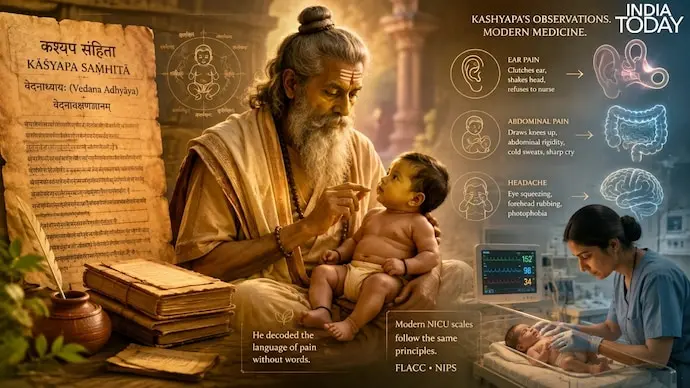
The Kashyapa Samhita, an ancient Indian medical text by sage Vriddha Kashyapa, describes how infants express pain through distinct bodily signs and behaviour, according to a report by India Today. The text's observations mirror principles used in modern neonatal pain assessment, such as the FLACC Scale and the Neonatal Infant Pain Scale.
In the Vedana Adhyaya, or 'Chapter on Knowledge of Pain Signs,' Kashyapa noted that infants with ear pain pull at their ears and refuse to breastfeed. He linked abdominal pain to knees drawn toward the chest and sharp cries, and headaches to eye-squeezing and sensitivity to light.
India Today reports that these observations were organised into a systematic diagnostic framework, treating infant cries as interpretable clues. The account recasts Vriddha Kashyapa as an early paediatric pioneer and one of the intellectual ancestors of modern neonatal diagnosis.
Indian Opinion Analysis
The coverage is uniform straight reporting from a single source, India Today, which frames the discovery as a remarkable precursor to modern science. There is no critical or alternative view presented. The article leans on a 'forgotten pioneer' narrative, emphasising ancient wisdom anticipating contemporary medicine. A measured reading recognises the structural similarity between ancient observational methods and modern scales, but notes the lack of clinical trials or historical corroboration beyond the text itself. The implication is that this may bolster interest in India's medical heritage, but does not change current neonatal practice. The key detail to watch is whether the claim gains peer-reviewed historical or medical validation.
Coverage: 1 source, 1 neutral
Source: indiatoday.in (neutral report)
This story was synthesised by AI from the source linked above. Methodology and corrections.