

















Now Reading: Bengaluru campaigners hug 3.3-billion-year-old rock to save Lalbagh from tunnel project
-
01
Bengaluru campaigners hug 3.3-billion-year-old rock to save Lalbagh from tunnel project

Bengaluru campaigners hug 3.3-billion-year-old rock to save Lalbagh from tunnel project

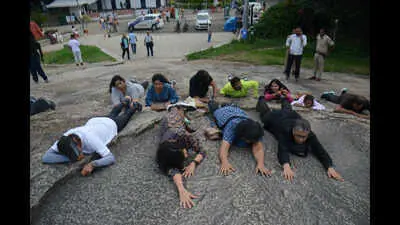
For three weeks, walkers and residents have formed human chains around a 3.3-billion-year-old rock at Lalbagh Botanical Garden to protest the proposed Hebbal, Silk Board Tunnel Road. The 17-km underground corridor would pass beneath the rock and Lalbagh Lake, prompting fears that tunnelling vibrations could crack the formation and drain the lake. Soil testing at the site has angered protesters, who say it should not proceed while a court case is pending.
The Lalbagh and Cubbon Park Walkers’ Association organised demonstrations on August 2 and 9 and plans a larger protest at Freedom Park with up to 10,000 people. Past campaigns successfully blocked a Metro plan and a multi-level parking complex that would have damaged the garden. “Every time, we’ve had to fight to keep the garden as it is,” said long-time walker B V Sridhar Rao. “Now it’s the rock.”
Protesters say they support development but demand the tunnel be re-routed away from Lalbagh and Cubbon Park. Public Interest Litigations against the project were filed in the Karnataka High Court, which scheduled the next hearing for September 3. Association president S Umesh Kumar said the group will discuss next steps before the court date. “We believe the court will give the right judgment,” he added.
Indian Opinion Analysis
Lalbagh’s Peninsular Gneiss is among the oldest exposed rock surfaces on Earth, comparable to the Jack Hills of Australia. The Bengaluru tunnel, part of the state’s flagship decongestion plan, is estimated to cost roughly Rs 11,000 crore. If vibrations from boring machines destabilise the lake bed, the garden’s 215-acre ecosystem could lose its only water body. The Karnataka High Court will hear the PILs on September 3. The key question is whether the National Highway Authority can re-route the tunnel without pushing costs above the approved estimate. Watch for the court’s interim order on whether soil testing can resume.
Source: timesofindia.indiatimes.com
This story was synthesised by AI from the source linked above. Methodology and corrections.