











Now Reading: Andhra HC says Hindu marriage now a contract, not sacrament
-
01
Andhra HC says Hindu marriage now a contract, not sacrament


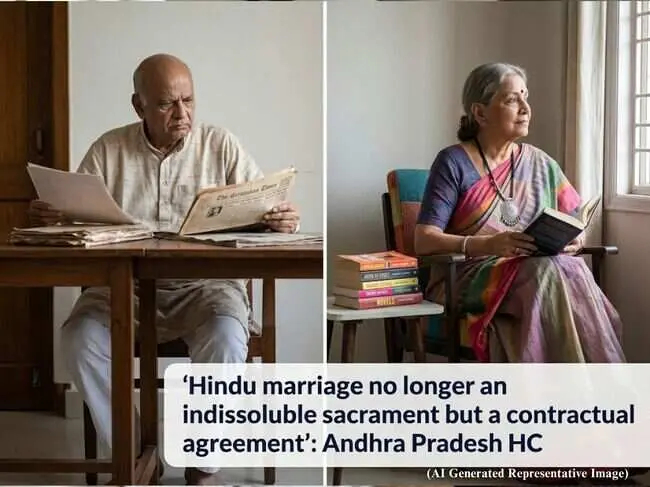
The Andhra Pradesh High Court dissolved a marriage solemnised in 1972 between a couple who have lived separately since 1978, waiving the mandatory six-month cooling-off period under the Hindu Marriage Act. A division bench of Justice Battu Devanand and Justice Sunitha Gandham ruled on August 13, 2026 that the waiting period is directory, not mandatory, and cannot be used to prolong agony when a marriage has irretrievably broken down. The court observed that Hindu marriage has shifted from an indissoluble sacrament to a contractual agreement.
Separately, the Madras High Court suggested amending Section 15 of the Hindu Marriage Act to prevent pending appeals from blocking remarriage indefinitely. A division bench of Justices GR Swaminathan and MD Sumathi held that the right to marry is a human right, and restrictions on it must be strictly construed. The court said an appellant should obtain an interim stay within two months, or the successful spouse should be free to remarry.
Indian Opinion Analysis
Both sources report the rulings neutrally, but each foregrounds a different court. Economic Times leads with the Andhra HC's observation that Hindu marriage is now a contractual agreement, a framing that emphasises legal evolution. Bar & Bench leads with the Madras HC's human-rights argument about remarriage, emphasising individual liberty. Neither overstates or omits key details. The measured takeaway is that two high courts have independently signalled that matrimonial law must adapt to modern realities: one by waiving procedural delays, the other by proposing structural amendments. Watch whether Parliament takes up the Madras HC's suggestion to amend Section 15.
Coverage: 2 sources, 2 neutral
Sources (2): economictimes.indiatimes.com (neutral report), barandbench.com (neutral report)
This story was synthesised by AI from the 2 sources linked above. Methodology and corrections.
Updated: this story now draws on 2 sources.