

















Now Reading: Punjab stubble fires cross 100 this season, topping last year’s count
-
01
Punjab stubble fires cross 100 this season, topping last year’s count


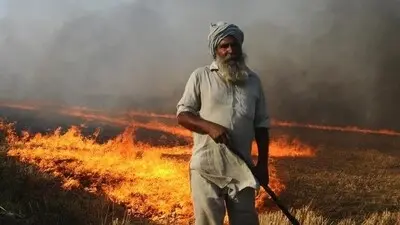
Punjab's farm-fire count crossed 100 on Thursday, 8 October 2026, with 15 fresh stubble burning cases taking the cumulative tally to 103, eight more than the 95 incidents recorded during the corresponding period last year, Hindustan Times reports, citing data from the Commission for Air Quality Management (CAQM).
Amritsar recorded the highest number of cases at 59, followed by Tarn Taran with 26. Authorities have imposed environmental compensation totalling ₹1.80 lakh across 36 cases, with ₹1 lakh recovered so far, and one FIR has been registered under Section 223 of the Bharatiya Nyaya Sanhita.
The Hindu reports that the practice is driven by the Punjab Preservation of Sub-Soil Water Act 2009, which delayed paddy transplantation and shortened the window for wheat sowing to 10 to 15 days, plus a procurement system that buys 87% of Punjab's paddy at minimum support price, discouraging crop diversification. Punjab has submitted a five-year plan to CAQM aiming for zero stubble burning by 2030.
Indian Opinion Analysis
The Hindu frames the story around the structural causes, groundwater depletion laws, short sowing windows, and the paddy-wheat incentive system, and treats the rising fire count as a symptom of a policy trap. Hindustan Times leads with the 103-fire tally, year-on-year increase and CAQM enforcement data, foregrounding the immediate compliance challenge. Both outlets report the same CAQM data and the 2030 zero-burning plan, but The Hindu omits the enforcement figures and FIR count entirely, while Hindustan Times does not cite the PPSSWA 2009 or procurement ratios that The Hindu says lock farmers into the cycle. The difference is one of lens: Hindustan Times reports the problem as an ongoing enforcement contest, The Hindu as an incentive design failure. Neither covers the other's core frame.
Coverage: 2 sources, 1 government-critical, 1 neutral
Sources (2): thehindu.com (government critical), hindustantimes.com (neutral report)
This brief was synthesised by AI from the 2 sources linked above, so one read covers every framing they carry. Methodology and corrections.