









Now Reading: Siang dam strategic to counter China’s river project: Arunachal CM
-
01
Siang dam strategic to counter China’s river project: Arunachal CM


The Story in Brief
Chief Minister Pema Khandu on Monday (16 November 2026) termed the proposed Siang Upper Multipurpose Project (SUMP) a strategic necessity for India's water security and defence, pointing to China's reported 60,000-MW hydropower project on the Yarlung Tsangpo in Tibet. Speaking in Itanagar on National Press Day, he said SUMP's primary objective was to regulate upstream flows and shield downstream regions, not generate power.

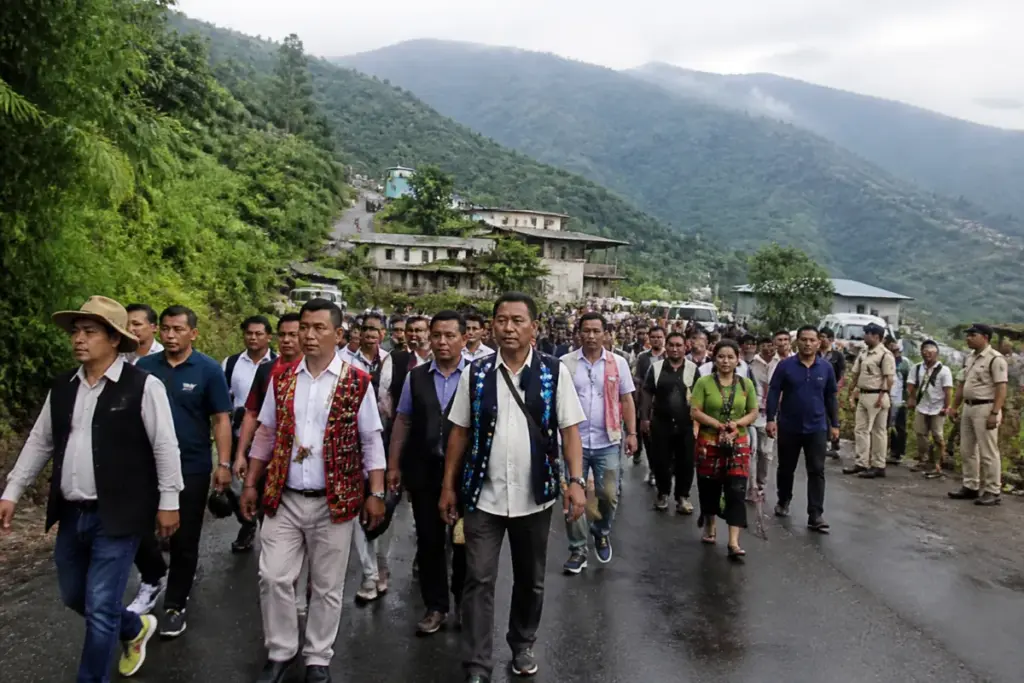
Khandu said the proposed SUMP would have a storage capacity of 9.2 billion cubic metres against the Chinese project's reported 5.2 BCM, enabling India to respond to changes in river discharge. He acknowledged the government had not adequately explained the project to communities and said committees had been formed to build awareness amid violent protests that have drawn security deployment. Khandu assured that affected families would receive compensation and rehabilitation, and said the pre-feasibility report was only an initial technical exercise, not a final decision on implementation.
Indian Opinion Analysis
All four outlets report Pema Khandu's National Press Day remarks in uniform straight news style, each closely tracking the PTI or an identical feed. The chief minister frames SUMP as a strategic necessity driven by China's 60,000-MW Yarlung Tsangpo project, emphasising the 9.2 BCM versus 5.2 BCM storage advantage, the absence of a binding water-sharing framework, and the need to regulate downstream flows. Each version also carries Khandu's acknowledgment of inadequate grassroots communication, his assurance of compensation and rehabilitation, and his call for dialogue amid violent protests. Hindustan Times, India Today NE and Assam Tribune additionally quote Khandu condemning destruction of houses and agricultural land during the agitation. The coverage is uniform: no outlet questions the official rationale, adds independent analysis, or gives platform to protesting voices beyond Khandu's references. The 60,000-MW figure for China's project is accepted without verification, and no source mentions an alternative timeline for SUMP's feasibility studies beyond the ongoing PFR.
Coverage: 3 sources, 3 neutral
Sources (3): Syndicated copy (carried by hindustantimes.com, indiatodayne.in), northeastlivetv.com (neutral report), assamtribune.com (neutral report)
This brief was synthesised by AI from the 3 sources linked above, so one read covers every framing they carry. Methodology and corrections.