















Now Reading: Telangana drought pits water needs against data-centre push
-
01
Telangana drought pits water needs against data-centre push


The Story in Brief
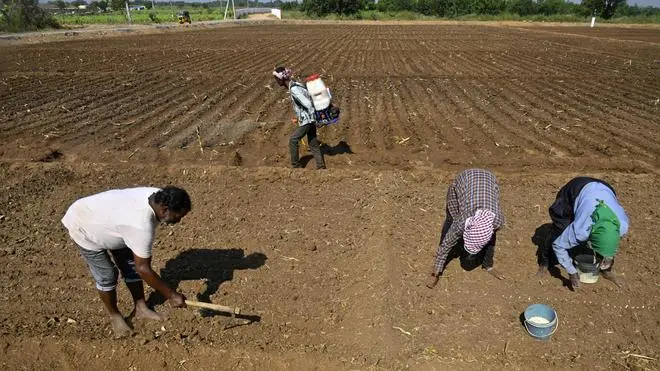
Telangana faces its worst drought in nearly a decade, with Chief Minister A Revanth Reddy warning of a crisis of historical magnitude after a 17 per cent rainfall deficit. Half the state’s agricultural borewells have dried up, reservoirs are at 31 per cent capacity, and Hyderabad’s drinking water supply from Singur and Manjeera reservoirs may last only till the first fortnight of December, according to New Indian Express. The government has appealed to farmers to delay sowing of water-intensive crops and plans to draw water from the Godavari and Krishna through new pipelines.
The situation is compounded by a record peak power demand of about 20,000 MW and reduced hydroelectric generation. The state plans to lead a delegation to the Centre seeking a Rs 20,000 crore relief package, immediate release of National Disaster Response Fund resources, a relaxation of the borrowing limit, and a 1,500-MW power allocation. The BRS has termed it a ‘Congress-made drought’ over the Kaleshwaram project, but the government says the National Dam Safety Authority has forbidden use of its damaged barrages.
The Hindu reports that the same government is planning a 1,500-acre data-centre city near Hyderabad with a 5 GW target by 2029, while the state’s drought-affected areas include districts where Google, Adani and Reliance are building data centres. The state has mandated that only treated waste-water be used for non-drinking purposes including data centres, but has not disclosed the project’s total water demand.
Indian Opinion Analysis
The Hindu’s piece builds the story around the contradiction between data-centre expansion and water scarcity, naming specific companies and questioning disclosure norms, while New Indian Express frames the crisis as an all-party governance challenge requiring Centre-State cooperation and criticises the government’s late response. Both agree on the drought’s severity, reservoir levels and power demand figures, but The Hindu foregrounds the resource conflict with industry, and New Indian Express foregrounds political blame and the need for unity. On the data-centre angle, The Hindu provides estimated water demand figures and questions government planning, while New Indian Express notes a treated waste-water mandate without further scrutiny. The balanced reading is that the drought is acute and multi-dimensional, and the competing priorities between farming, drinking water and industrial infrastructure remain unresolved as the state seeks Rs 20,000 crore in relief from the Centre.
Coverage: 2 sources, 1 government-critical, 1 neutral
Sources (2): thehindu.com (government critical), newindianexpress.com (neutral report)
This brief was synthesised by AI from the 2 sources linked above, so one read covers every framing they carry. Methodology and corrections.