



















Now Reading: Bengaluru techie earning Rs 1.8 lakh faced Rs 2.5 lakh ICU bill crisis
-
01
Bengaluru techie earning Rs 1.8 lakh faced Rs 2.5 lakh ICU bill crisis

Bengaluru techie earning Rs 1.8 lakh faced Rs 2.5 lakh ICU bill crisis

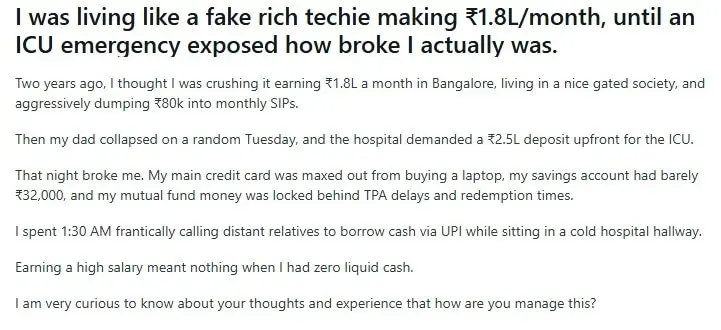
A Bengaluru tech professional earning Rs 1.8 lakh a month faced a sudden financial crisis when his father was hospitalised. The hospital demanded a Rs 2.5 lakh deposit for the ICU, but the employee had only Rs 32,000 in his savings account. His mutual fund investments could not be liquidated quickly, and his main credit card was nearly maxed out after a laptop purchase.
Posting on Reddit, he described sitting in the hospital corridor at 1:30 AM, calling distant relatives to borrow cash. He had been investing Rs 80,000 monthly in SIPs and believed he was financially secure. The experience taught him that having money in investments is not the same as having cash available for emergencies.
The post has become a cautionary tale for young professionals who prioritise long-term investing over maintaining an emergency fund. Financial planners advise keeping at least six months of expenses in readily accessible savings before locking money into illiquid instruments.
Indian Opinion Analysis
The story illustrates a financial reality that standard personal-finance advice often skips. The Insurance Regulatory and Development Authority of India requires all health insurers to offer a 30-day free-look period, but the critical gap the post highlights is liquidity: even a well-insured person may need cash upfront before the TPA settles the claim. The RBI's 2019 guidelines on medical insurance portability do not address the speed of pre-authorisation processing. With medical inflation at 14% annually according to industry body FICCI, the gap between an average family's liquid savings and a typical ICU deposit keeps widening. The Reddit user's next financial step would logically be building a dedicated emergency fund of at least six months' expenses in a savings account or liquid fund, as recommended by the Securities and Exchange Board of India's investor education framework.
Source: aajtak.in
This brief was synthesised by AI from the source linked above. Methodology and corrections.