
















Now Reading: Ex-diplomat, Chinese scholar clash over India-China fault lines
-
01
Ex-diplomat, Chinese scholar clash over India-China fault lines



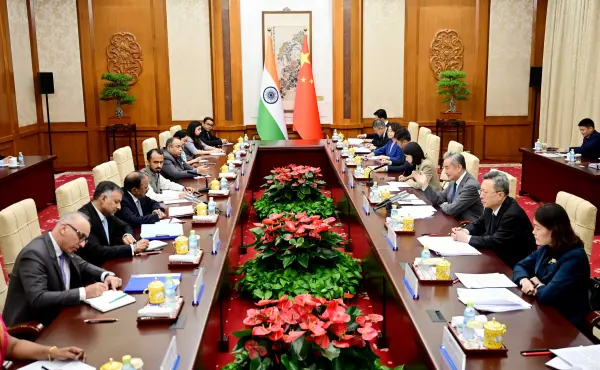
A former Indian foreign secretary and a Chinese professor have clashed over the root cause of the bitter India-China rivalry. Nirupama Rao, who also served as India’s ambassador to China from 2006 to 2009, and Lin Minwang, a Fudan University scholar, disagreed on whether history or politics is the bigger barrier in an exchange published by the South China Morning Post. Rao represented India’s diplomatic perspective, while Lin offered the Chinese academic view.

Lin argued that the 1962 war has become a core part of India’s national identity, making it difficult for New Delhi to abandon its narrative of China as an expansionist power without rewriting its own history. He said changing that perception would require altering deep-rooted national identity narratives. He also noted that more Chinese now hold negative views of India, partly because access to foreign views online has grown since Covid-19.
The debate also touched on the border dispute, Pakistan’s role, and India’s ties with the United States. The two diplomats-turned-authors examined whether trust can be rebuilt between Beijing and New Delhi in an increasingly multipolar world.
Indian Opinion Analysis
The 1962 war remains the defining scar in India-China relations, but the Line of Actual Control (LAC) in eastern Ladakh has been the active flashpoint since the 2020 Galwan clash, after decades of relative peace. Border talks have continued bilaterally and through military-level dialogues, but no disengagement or de-escalation has been agreed upon for Depsang and Demchok, the two remaining friction points. The core dispute is over the 3,500-km LAC, which is not a legally demarcated border. China’s claim on Arunachal Pradesh and India’s claim on Aksai Chin, which China controls, remain unresolved. Next: the 31st round of the Working Mechanism for Consultation and Coordination (WMCC) on India-China border affairs, expected later in 2025.
Source: scmp.com
This story was synthesised by AI from the source linked above. Methodology and corrections.