














Now Reading: ICAR develops new hot water treatment to boost mango exports
-
01
ICAR develops new hot water treatment to boost mango exports


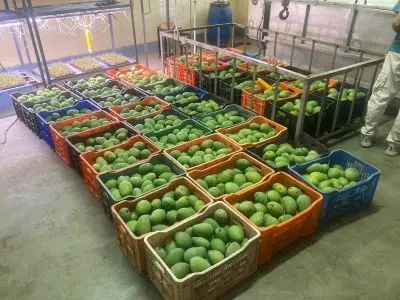
The Indian Council of Agricultural Research's Indian Institute of Horticultural Research (ICAR-IIHR) in Bengaluru has developed a new hot water treatment protocol to control fruit fly and anthracnose in mangoes, potentially boosting exports. The treatment involves immersing mature green mangoes in hot water at 55 degrees Celsius for 20 minutes, followed by a dip in 5 percent salt water for 30 minutes.
Previously, separate treatments were needed for fruit fly (48 degrees Celsius for 60 minutes) and anthracnose (52 degrees Celsius for 5-10 minutes). The old fruit fly treatment caused internal breakdown in Alphonso mangoes. The new protocol controls both pests without damaging the fruit and reduces quarantine treatment time by a third, pending approval from the quarantine department.
ICAR-IIHR has already facilitated a trial shipment of 1.2 tonnes of Banganapalli mangoes to Brunei on June 25, 2026, using the new protocol. The buyer confirmed the mangoes arrived in good condition, free of pests and with satisfactory quality.
Indian Opinion Analysis
This development addresses a long-standing barrier for Indian mango exports: importing countries require quarantine treatments that are both effective and non-damaging. Alphonso, the most prized export variety, was especially vulnerable to internal breakdown under the older protocol. The new single-step treatment cuts processing time by one-third, which could significantly lower costs for exporters and reduce post-harvest losses estimated at 20-30 percent for fresh produce. The key next step is approval from the Directorate of Plant Protection, Quarantine and Storage (DPPQ&S), after which the protocol can be used for all export destinations. Watch for whether the quarantine department clears this for use with key markets such as the United States, Japan, and the European Union, where India competes with Pakistan and Mexico.
Source: icar.org.in
This story was synthesised by AI from the source linked above. Methodology and corrections.