


















Now Reading: India solar potential of 3,300 GW can power AI data centres
-
01
India solar potential of 3,300 GW can power AI data centres


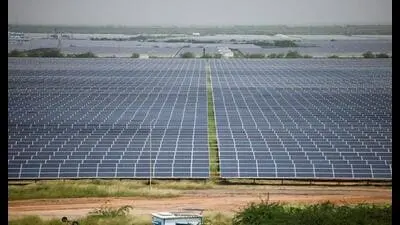
India's assessed solar potential has been revised upward to over 3,300 GW of ground-mounted capacity alone, according to a 2025 estimate by the National Institute of Solar Energy working with ISRO. The Energy and Resources Institute puts total capacity, including rooftop and floating, at just over 10,800 GW. This capacity overlaps with Bengaluru, Hyderabad, Chennai and Pune, the cities where India's AI infrastructure is being built, unlike US and Chinese tech hubs which lack strong solar potential.
Installed solar capacity crossed 162 GW by mid-2026, making India the world's third-largest solar market. However, battery storage stood at under 6 GWh, far short of the 160-240 GWh needed by 2030. Grid operators curtailed over 8,000 GWh of solar power in the latest quarter due to insufficient storage. Investing in large-scale storage, batteries, pumped hydro or compressed air, could turn the daytime solar glut into continuous baseload for AI data centres.
Water consumption concerns may be overstated: Google says a Gemini query uses only 0.24 millilitres, thanks to closed-loop cooling. Still, global data centre water use is projected to rise from 4.5 trillion litres in 2025 to 9.3 trillion by 2030. Chennai and Bengaluru are among India's most water-stressed cities, so planning for reclaimed water and closed-loop cooling at the design stage is advised to pre-empt local opposition.
Indian Opinion Analysis
India's solar potential far exceeds its current capacity, but without storage, the daytime surplus is wasted. The 2030 battery storage target of 160-240 GWh is a critical benchmark: meeting it would allow data centers to run on round-the-clock solar power. The tech corridors in Bengaluru, Hyderabad, Chennai and Pune are also among the country's most water-stressed cities, making water planning at the design stage a condition for local acceptance. The next signal to watch is whether the government includes storage mandates in its upcoming data centre policy or AI mission guidelines.
Source: hindustantimes.com
This story was synthesised by AI from the source linked above. Methodology and corrections.