






Now Reading: Isro completes key crew module separation test for Gaganyaan G1
-
01
Isro completes key crew module separation test for Gaganyaan G1


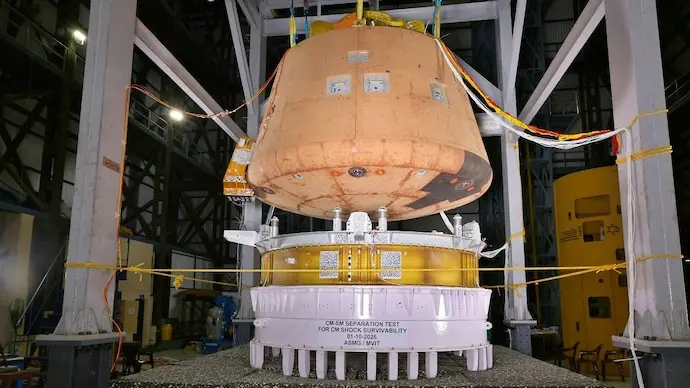
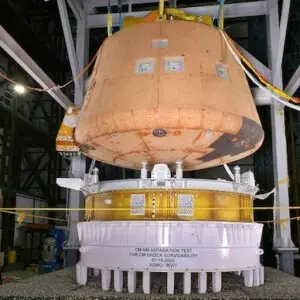
The Indian Space Research Organisation (Isro) has successfully completed critical separation tests for the Gaganyaan spacecraft, validating the system that will separate the Crew Module (CM) from the Service Module (SM) before re-entry. The tests were conducted at the Vikram Sarabhai Space Centre in Thiruvananthapuram, simulating the integrated CM-SM assembly with extensive instrumentation.
The G1 uncrewed mission, which will test the spacecraft systems before a crewed flight, is targeted for launch in 2026. The separation sequence involves multiple pyrotechnic devices and jettisoning mechanisms, failure could jeopardise the crew module's return. Isro said the results provide necessary confidence in the separation system for the upcoming G1 mission.
The Gaganyaan programme aims to demonstrate India's human spaceflight capability by launching a crew of three to an orbit of 400 km for a three-day mission and returning them safely to earth, with a landing in Indian sea waters.
Indian Opinion Analysis
Both sources report the same event as a straight achievement story, with near-identical technical details and no political or editorial framing. India Today leads with Isro gearing up for the maiden launch and adds an explanatory section on why the test matters, while The Hindu provides a more concise agency-style report with the space agency's official statement. Neither outlet challenges, omits, or critiques the timeline or programme. The coverage is uniform: a neutral, technically focused account of a milestone on the path to India's first human spaceflight. The next concrete step is the G1 uncrewed launch, which Isro still targets for 2026.
Coverage: 2 sources, 2 neutral
Sources (2): indiatoday.in (neutral report), thehindu.com (neutral report)
This brief was synthesised by AI from the 2 sources linked above, so one read covers every framing they carry. Methodology and corrections.