













Now Reading: Kolkata govt hospitals to refer critical patients to private ones
-
01
Kolkata govt hospitals to refer critical patients to private ones


The Story in Brief
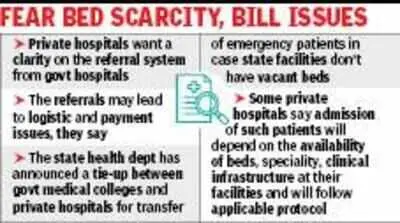
Kolkata’s government hospitals will now refer critical patients to private facilities free of cost under a new emergency system announced by the state health department. A dedicated control room at Swasthya Bhawan will coordinate transfers after patients are stabilised, with government ambulances providing transport. Six government medical colleges have been mapped to nearby private hospitals, with SSKM Hospital linked to KPC Medical College as a pilot.
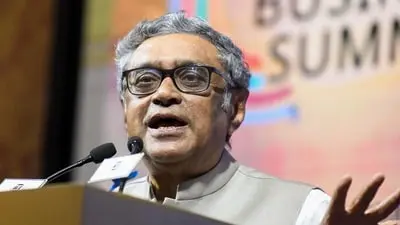
Health Minister Sharadwat Mukherjee said private hospitals, which received land at subsidised rates, should provide beds in return. The system will use existing health schemes like Swasthya Sathi to cover costs. However, private hospitals have raised concerns about bed scarcity and payment. Rupak Barua of the Association of Hospitals of Eastern India said clarity is needed on whether all hospitals are included and how bills will be settled.
The fire department has also begun safety audits at major private hospitals in south Kolkata, inspecting fire systems and emergency response mechanisms. Audits at Manipal Hospital, Ruby General Hospital, Belle Vue Clinic, and others took place on 2 and 3 October, with plans to cover all government and private institutions later.
Indian Opinion Analysis
The Indian Express leads with the government’s initiative as a ‘unique’ solution, quoting the health minister and emphasising patient benefits. The Times of India, in its 2 October report, foregrounds private hospital wariness over bed availability and payment, giving voice to operational concerns. Both are essentially neutral reporting but frame the story from opposite sides of the same announcement. ThePrint’s unrelated Delhi High Court story covers administrative failures in the capital, not Kolkata. The Times of India’s 3 October audit report adds a separate safety angle. A balanced reading is that the government has announced a plan with clear logistics but unresolved financial and capacity issues, reflected in the private sector’s caution.
Coverage: 4 sources, 4 neutral
Sources (4): indianexpress.com (neutral report), timesofindia.indiatimes.com (neutral report), theprint.in (neutral report), timesofindia.indiatimes.com (2) (neutral report)
This brief was synthesised by AI from the 4 sources linked above, so one read covers every framing they carry. Methodology and corrections.
Update, 4 October 2026: this story now draws on 4 sources.