















Now Reading: Nepal flash flood: 3 theories, India on alert for Gandak surge
-
01
Nepal flash flood: 3 theories, India on alert for Gandak surge


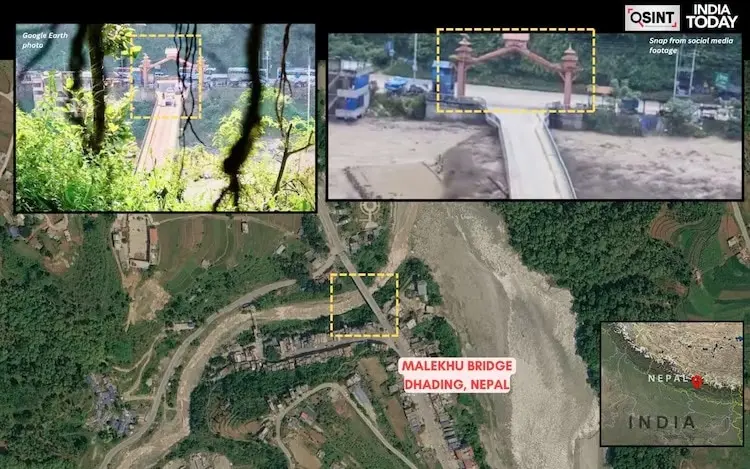
A sudden flash flood in Nepal’s Bhotekoshi river on Wednesday morning swept away bridges, roads and power infrastructure in Rasuva, Nuwakot, Dhading and Chitwan districts. Nepal’s disaster authority is investigating three possible causes: a landslide that dammed and then released the river, seismic shaking, or a glacial lake outburst flood (GLOF). The US Geological Survey has revised its initial earthquake reading to a landslide event, weakening the seismic theory. Senior meteorologist Min Kumar Aryal told Aaj Tak that Rasuva recorded only 7 mm of rain in 24 hours, making heavy rainfall an unlikely trigger.
The floodwater is flowing through the Trishuli-Narayani-Gandak river system towards India’s border. The Central Water Commission has advised Bihar’s West Champaran, East Champaran, Gopalganj, Saran, Muzaffarpur and Vaishali districts, and Uttar Pradesh’s Maharajganj and Kushinagar districts, to stay alert. NDRF teams have been deployed in Bettiah, Gopalganj and Muzaffarpur. The flood peak may slow as the river spreads over the plains, but officials say the path is clear: Nepal’s Narayani becomes India’s Gandak, which meets the Ganga near Hajipur.
Indian Opinion Analysis
Aaj Tak’s two stories frame the same event in contrasting registers. The first leads with speculative investigative reporting on three flood causes, attributing each to Nepali or international agencies and quantifying the plausibility of GLOF versus landslide. The second shifts immediately to climactic and developmental alarm, describing the flood as a climate-change signal and a failure of Himalayan infrastructure. The first story stays data-driven, the second is argument-driven: it blames under-preparedness and environmental degradation. Neither denies that multiple explanations exist, but the second story’s language of ‘vital signs’ and ‘preparedness failure’ pushes a structural critique absent from the first. Together the coverage confirms the causes are uncertain but the need for trans-Himalayan real-time data sharing is concrete. Nepal’s disaster authority publishes its formal cause assessment in September, and the Bihar district administration will release river-gauge readings daily until the flood wave passes.
Coverage: 2 sources, 1 government-critical, 1 neutral
Sources (2): aajtak.in (neutral report), aajtak.in (2) (government critical)
This brief was synthesised by AI from the 2 sources linked above, so one read covers every framing they carry. Methodology and corrections.
Updated: this story now draws on 2 sources.