





















Now Reading: RBI brings 25 card payment circulars into one framework
-
01
RBI brings 25 card payment circulars into one framework



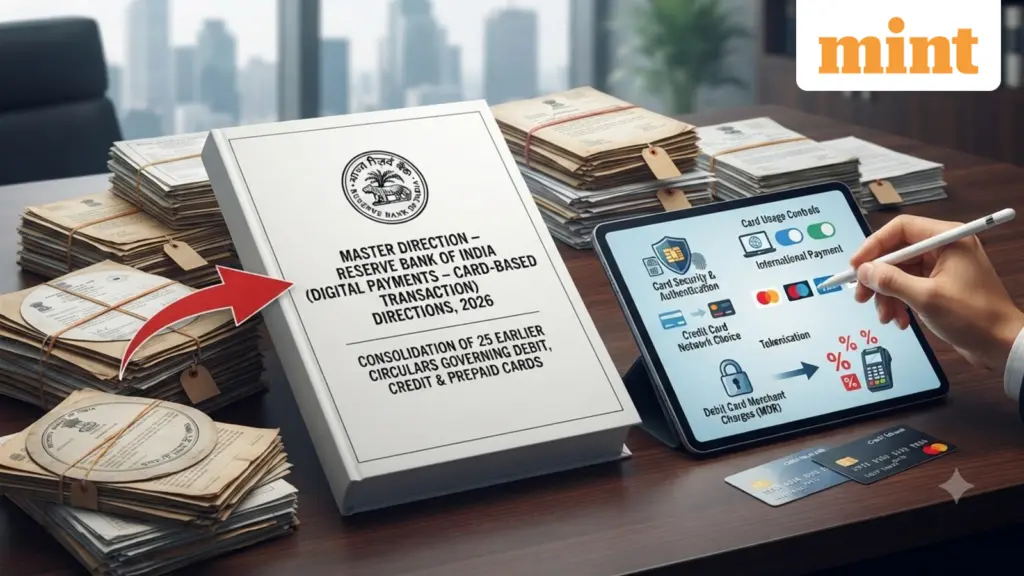
AI-generated illustration
The Story in Brief
The Reserve Bank of India issued a single framework on 27 November, consolidating 25 circulars on debit, credit and prepaid card payments. The directions took effect immediately and apply to payment system providers and participants, including banks and non-bank entities. Mint reports that the framework gathers existing rules rather than introducing new transaction limits, authentication requirements or card facilities.
The directions cover card security, authentication, tokenisation, card controls and merchant discount rates. Business Standard reports that customers must give explicit consent, authenticated through an additional factor, to register cards for tokenisation, including renewed or replacement cards with previously registered merchants. Issuers must offer ways to view and deregister tokens, and provide controls to switch transaction channels on or off. Debit-card MDR caps remain 0.40% and 0.90% for small and other merchants at physical PoS and online, and 0.30% and 0.80% for QR payments. Business Standard also reports maximum charges of Rs. 200 and Rs. 1,000 per transaction, respectively. Earlier approvals and actions remain valid under the consolidated directions.
Indian Opinion Analysis
Both outlets present the RBI’s action as a regulatory consolidation, but they give different weight to its cardholder implications. Mint stresses that the framework does not announce new usage facilities or authentication requirements, keeping the focus on how existing rules are organised. Business Standard leads with explicit consent for tokenisation and details customer controls, audits and maximum MDR charges, making safeguards and compliance more prominent. Read together, the coverage indicates that consolidation preserves many existing requirements while setting out specific tokenisation obligations, it does not establish that cardholders gain new facilities. Business Standard says tokenisation audits must be conducted at least annually, with reports and monthly transaction data submitted to the RBI.
Coverage: 2 sources, 2 neutral
Sources (2): livemint.com (neutral report), business-standard.com (neutral report)
This brief was synthesised by AI from the 2 sources linked above, so one read covers every framing they carry. Methodology and corrections.