













Now Reading: 40% maintenance hike at Noida society sparks protests, rules questioned
-
01
40% maintenance hike at Noida society sparks protests, rules questioned

40% maintenance hike at Noida society sparks protests, rules questioned

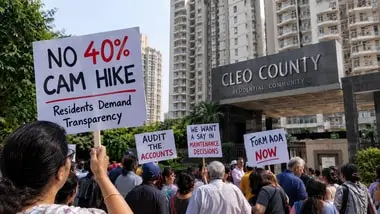
A 40% hike in common area maintenance charges at Noida's Cleo County has triggered repeated protests since 5 September. The charge was revised from Rs 2.75 to Rs 3.85 per square foot,…
A 40% hike in common area maintenance charges at Noida's Cleo County has triggered repeated protests since 5 September. The charge was revised from Rs 2.75 to Rs 3.85 per square foot, applied retrospectively from April, according to residents. The society in Sector 121 has over 2,500 units, and residents of around 1,450 units have signed a petition opposing the increase.
Residents have also raised concerns over the absence of an Apartment Owners' Association (AOA) and demanded greater transparency in maintenance accounts, an independent forensic audit, and disclosure of the Interest Free Maintenance Security. The developer defended the hike, citing higher minimum wages and operating costs, and said audited records were shared through open forums.
Under the Uttar Pradesh Apartment Ownership Act, 2010, apartment owners cannot avoid common expenses. UP RERA chairman Sanjay R Bhoosreddy has said formation of an AOA is a joint responsibility of the developer and homebuyers, and its general body can determine maintenance charges by majority. The dispute highlights the transition from developer-led to resident-led management.
Indian Opinion Analysis
The Cleo County dispute is a recurring flashpoint in India's large gated societies, where developers often retain control of maintenance and common funds years after possession. Under the UP Apartment Rules, 2011, the AOA general body has the power to set common charges by majority, but forming one requires the developer to hand over records and funds. The real tension is over the Interest Free Maintenance Security (IFMS) collected from buyers: UP RERA's July 2024 framework mandates its transfer to the AOA during handover, but societies with no AOA have no body to receive it. The outcome at Cleo County could set a precedent for similar disputes across Noida's high-density complexes, where thousands of families pay escalating charges without a resident-led body to audit them. The next step is whether residents approach UP RERA or the district magistrate to enforce AOA formation and fund transparency.
Source: livemint.com
This brief was synthesised by AI from the source linked above.