




















Now Reading: Aditya-L1 helps decode coronal mass ejection expansion
-
01
Aditya-L1 helps decode coronal mass ejection expansion


The Story in Brief
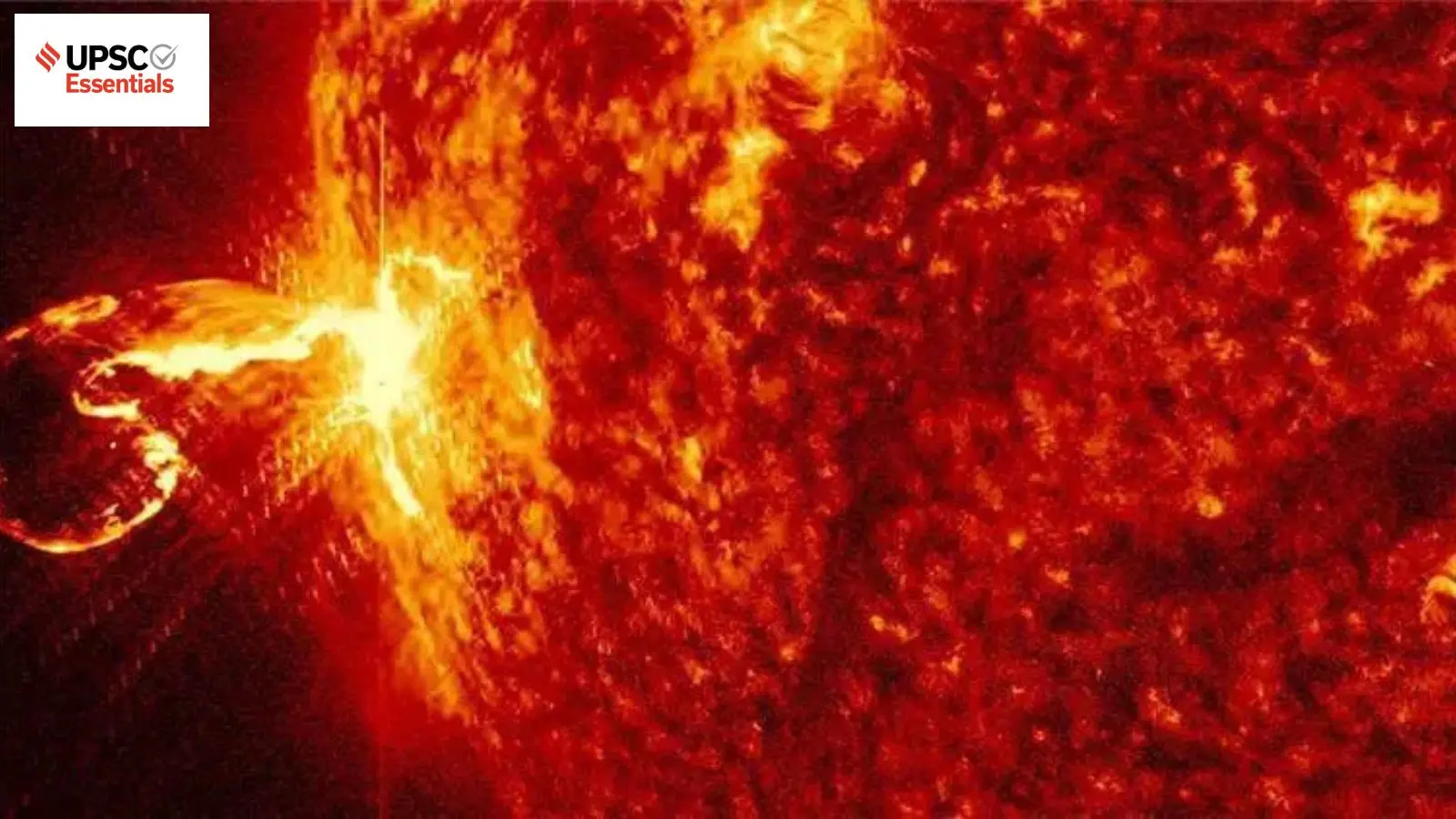
Indian scientists using ISRO’s Aditya-L1 solar observatory have gained new insights into how coronal mass ejections (CMEs) expand near the Sun, according to a PIB release. The team combined spectroscopic data from the Visible Emission Line Coronagraph (VELC) onboard Aditya-L1 with images from NASA’s Solar Dynamics Observatory and 3D modelling.
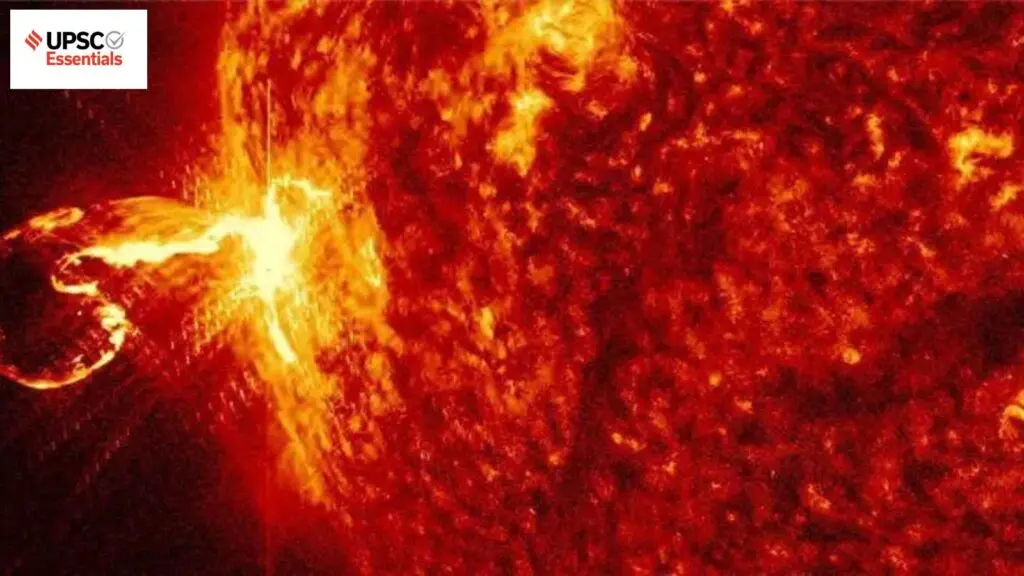
A CME is a burst of hot, magnetised plasma released from the Sun’s corona. When directed toward Earth, they can disrupt satellites and communications. VELC, developed by the Indian Institute of Astrophysics (IIA) with ISRO support, uses Doppler spectroscopy to measure plasma motion along the line of sight, overcoming the limitation of conventional coronagraphs that image CMEs only in two dimensions.
Separately, a new silicon chip allowing terahertz waves to pass with little loss while carrying data at 100 Gbit/s points to compact circuits for future 6G technologies, PIB said. Terahertz waves (0.1 to 10 THz, wavelength 3 mm to 30 μm) lie between microwaves and infrared.
Indian Opinion Analysis
The Aditya-L1 finding directly improves CME speed and trajectory prediction, which is critical for safeguarding satellites and power grids from geomagnetic storms. VELC’s spectroscopic capability fills a gap that imaging-only coronagraphs leave open. The terahertz chip breakthrough, meanwhile, addresses a key engineering barrier for 6G. Both results are early-stage: the CME model needs further validation, and the chip remains a lab demonstration before commercial deployment.
Source: indianexpress.com
This brief was synthesised by AI from the source linked above. Methodology and corrections.