



















Now Reading: Air India slashes Delhi cargo transit time to 5-8 hours under new policy
-
01
Air India slashes Delhi cargo transit time to 5-8 hours under new policy

Air India slashes Delhi cargo transit time to 5-8 hours under new policy

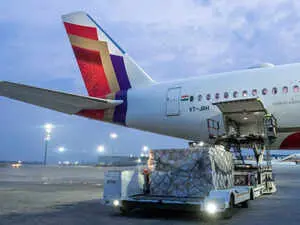
Air India has reduced cargo connection time at Delhi Airport from 36-48 hours to 5-8 hours under a pilot of the government's new cargo transshipment policy on the Chennai-Delhi-Frankfurt corridor. The 90-day Proof of Concept, approved by the Bureau of Civil Aviation Security, allows eligible shipments to remain securely packed during transit, eliminating piece-level re-screening. Between June 20 and August 20, the airline moved 300 metric tonnes of cargo on the corridor, doubling average daily volumes to 4.5 tonnes.
Air India will now expand the pilot to five more Indian origin cities, Ahmedabad, Bengaluru, Chennai, Hyderabad and Mumbai, with onward connections to Copenhagen, Frankfurt and London Heathrow. The airline recorded zero cargo loss or damage and improved Flown-as-Booked performance to 100% from 76%. Separately, Indian airports handled 10.8 lakh tonnes of freight in the April-June quarter, up 12% year-on-year, driven by demand from e-commerce, semiconductors and rerouting due to the West Asia crisis.
The new transshipment framework, subject to further regulatory approvals, is eventually intended to cover domestic-to-international, international-to-domestic and international-to-international cargo movements through Indian airports.
Indian Opinion Analysis
Economic Times leads with Air India's specific operational win under a government policy, framing the story as a success story of public-private coordination. Business Line takes a broader market view, omitting Air India entirely and focusing on sector-wide demand from e-commerce, semiconductors and West Asia routing shifts. Where Economic Times reports a zero-loss, 100% flown-as-booked result for one carrier, Business Line reports 12% quarterly tonnage growth across all Indian airports. The measured takeaway: Air India's pilot is one data point in a larger cargo boom driven by structural demand (semiconductors, e-commerce) and geopolitical rerouting (Iran-US tensions). Watch whether Air India's transit-time reduction translates into the 2-million-tonne annual transshipment potential it cites for Delhi, or whether that forecast assumes policy expansion that has yet to be approved for international-to-international movements.
Coverage: 2 sources, 1 pro-government, 1 neutral
Sources (2): economictimes.indiatimes.com (pro government), thehindubusinessline.com (neutral report)
This story was synthesised by AI from the 2 sources linked above. Methodology and corrections.
Updated: this story now draws on 2 sources.