











Now Reading: Article 25 is not absolute, Bombay HC rules on Kavad Yatra route
-
01
Article 25 is not absolute, Bombay HC rules on Kavad Yatra route


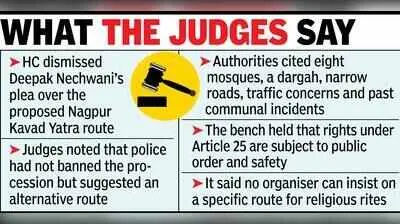
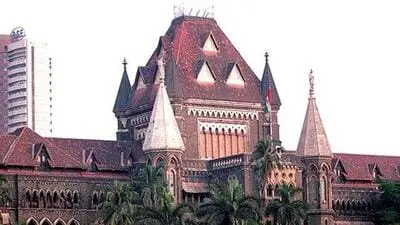
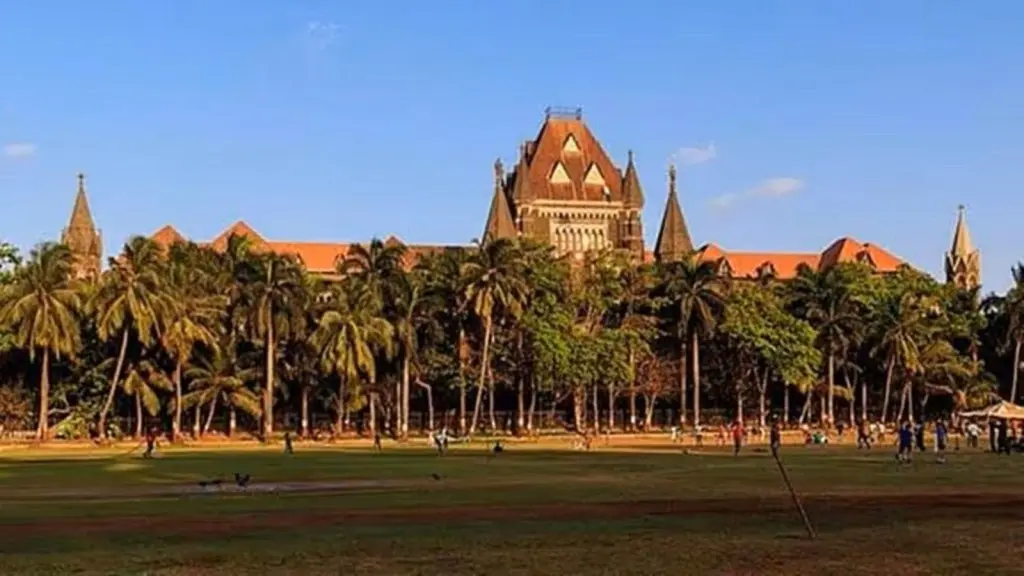
The Bombay High Court has ruled that the right to practise religion under Article 25 is not absolute and must yield to law and order, public interest, and the needs of other sections of society. A division bench in Nagpur dismissed a petition challenging police restrictions on the route of a proposed Kavad Yatra through Mominpura, a minority-dominated area.
The court found that the organiser, Deepak Nechwani, has no fundamental right to insist on a particular road for a religious procession when authorities have cited public order, traffic, and safety concerns. Police had offered an alternative route but denied the proposed one citing narrow roads, heavy traffic, eight mosques and a dargah along the route, and past incidents of communal unrest in the area.
The bench noted that the petitioner failed to provide details on traffic management, sound systems, estimated turnout, volunteers, and crowd-control arrangements. "The exercise of right to practise one's religion is one thing and to practise it in a particular way is another," the court said, citing an Allahabad High Court precedent.
Indian Opinion Analysis
The Nagpur bench of the Bombay High Court has delivered a significant ruling on the limits of religious processions. The court built on established precedent, including a 2023 Allahabad High Court judgment, to reaffirm that Article 25 of the Constitution permits reasonable restrictions. This case highlights a recurring tension in densely populated urban India: organisers claim a fundamental right to choose any route for religious events, while police cite practical concerns of public order and safety. The burden on the petitioner here was heavy, the court noted he failed to provide essential details like traffic management and volunteer numbers. Watch for the Supreme Court to potentially hear an appeal, which would clarify the balance between religious freedom and local regulation across all states.
Source: timesofindia.indiatimes.com
This story was synthesised by AI from the source linked above. Methodology and corrections.