

















Now Reading: Buddhist activist challenges Centre’s six-stanza Vande Mataram in Supreme Court
-
01
Buddhist activist challenges Centre’s six-stanza Vande Mataram in Supreme Court

Buddhist activist challenges Centre’s six-stanza Vande Mataram in Supreme Court


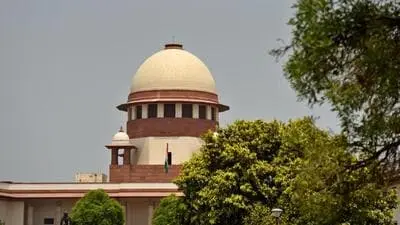
BD Borkar, a Buddhist activist and former BAMCEF president, has moved the Supreme Court challenging the Union government's January 28 and July 9, 2026 orders prescribing a six-stanza version of 'Vande Mataram' for official occasions. The petition, filed under Article 32, argues the directives violate secularism, fraternity, and fundamental rights, and that the Ministry of Home Affairs lacks authority to impose the song through executive orders.
The petitioner contends the two-stanza version sung since Independence is distinct from the six-stanza composition in Bankim Chandra Chatterjee's novel Anandamath, which invokes Hindu goddesses. The petition cites the 1937 Congress resolution adopting only the first two stanzas, and argues the Constituent Assembly in 1950 did not mandate all six. It also challenges the Prevention of Insults to National Honour (Amendment) Act, 2026, which extends penal protection to the National Song.
The petition argues compelling citizens to sing the six-stanza version violates Article 25(1), Article 19(1)(a), and Article 21, citing the Supreme Court's Bijoe Emmanuel judgment on the right to remain silent. A separate challenge by Carnatic musician T.M. Krishna was heard by the Supreme Court on September 22, which asked the Union government to reply without deciding the case.
Indian Opinion Analysis
LiveLaw's report is a straight, detailed account of the petition's arguments, attributing every claim to the petitioner without editorialising. The Hindu's piece is an opinion essay that frames the same policy as the reopening of a settled compromise, contrasting it with Gandhi's favoured song Vaishnava Jana To. Where LiveLaw neutrally reports the petitioner's secularism and fraternity arguments, The Hindu presents the two-stanza settlement as historically settled and the new law as its disruption. The Hindu also notes that Justice Bagchi observed that Bijoe Emmanuel still governs conscientious objectors, a detail LiveLaw omits. Neither source reports a next hearing date.
Coverage: 2 sources, 1 government-critical, 1 neutral
Sources (2): livelaw.in (neutral report), thehindu.com (government critical)
This brief was synthesised by AI from the 2 sources linked above, so one read covers every framing they carry. Methodology and corrections.