


















Now Reading: Date palm farming gives Malwa farmers sweet returns after kinnow losses
-
01
Date palm farming gives Malwa farmers sweet returns after kinnow losses

Date palm farming gives Malwa farmers sweet returns after kinnow losses

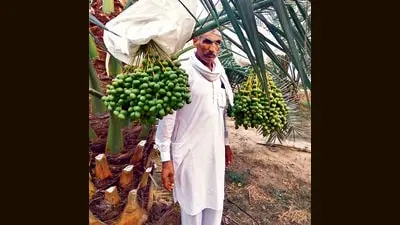
Progressive farmers in Punjab's Fazilka district have reported a successful maiden harvest of dates, raising hopes for cultivating the 'desert fruit' in the semi-arid Malwa region. Around 70 tissue-culture saplings can be planted per acre, costing Rs 5,000 each, and each tree yields an average of 1.5 quintals per season after 5-7 years. Farmer Vimal Kumar Bishnoi harvested 50 quintals from 155 saplings in July, selling at Rs 60-100 per kg.
Farmers and experts are seeking state subsidies and training under the crop diversification plan, as kinnow and cotton have suffered due to rising groundwater salinity and unfavourable climate. The Punjab Agricultural University says southwest Punjab's climate and sandy soils suit date palm varieties. Farmer Harpreet Singh Brar, who has scaled up to 7.5 acres, urges a policy to conserve groundwater by supporting date palm cultivation, citing Rajasthan's subsidy model. Scientist Anil Kamra said areas like Fazilka, Bathinda, Muktsar and Mansa have immense potential.
Indian Opinion Analysis
Punjab's crop diversification drive has struggled for years, with paddy remaining dominant due to assured procurement and power subsidies. Date palm, being less water-intensive and labour-light, offers an alternative, but the upfront cost of Rs 3.5 lakh per acre (70 saplings at Rs 5,000 each) is prohibitive without state support. Rajasthan already provides a 50-60% subsidy on tissue-culture saplings, making it a ready model. If Punjab replicates that, it could wean farmers off depleting groundwater in the Malwa belt. The next step to watch is whether the state budget includes a date palm subsidy scheme.
Tissue-culture plants, though costlier than offshoots, are disease-free and uniform-yielding. Farmer Ved Prakash's offshoots cost Rs 2,000 each but have lower yield and quality risk. The PAU's research station at Abohar is the technical anchor, its recommendation for tissue culture is based on field trials. The key number is the potential acreage shift: if even 5% of Punjab's cotton and kinnow area (roughly 4 lakh hectares) switches to dates, it could save substantial groundwater and boost farmer incomes.
Source: hindustantimes.com
This story was synthesised by AI from the source linked above. Methodology and corrections.