














Now Reading: Google DeepMind’s WeatherNext AI predicts cyclones up to 15 days ahead
-
01
Google DeepMind’s WeatherNext AI predicts cyclones up to 15 days ahead

Google DeepMind’s WeatherNext AI predicts cyclones up to 15 days ahead

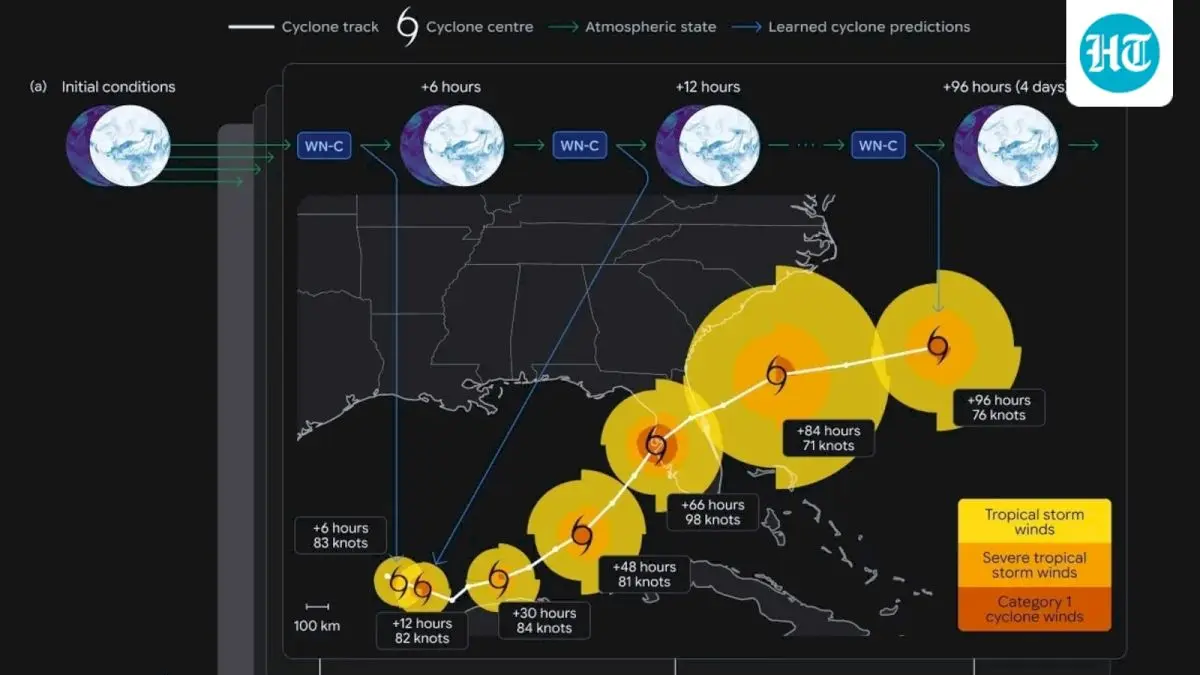
Google DeepMind has unveiled WeatherNext AI, a model that can predict a tropical cyclone's track, intensity and wind structure up to 15 days in advance. The system was built by researchers at…
The Story in Brief
Google DeepMind has unveiled WeatherNext AI, a model that can predict a tropical cyclone's track, intensity and wind structure up to 15 days in advance. The system was built by researchers at Google DeepMind and Google Research, working with the National Hurricane Center, the Cooperative Institute for Research in the Atmosphere, the UK Met Office and other agencies. It was trained on roughly 20 terabytes of global atmospheric data and historical observations from 5,000 past storms.
The model uses a unique combination of training, architecture and low-resolution inputs to bridge the gap between global weather forecasting and cyclone-specific prediction. The team says it achieves state-of-the-art accuracy. The announcement comes as Workday India released a separate report showing that while 89% of Indian employees say AI improves their work day, many are still burdened with disconnected systems that force humans to act as 'glue' between tools.

The Indian Opinion
Indian coastal states brace for cyclones every year, so any improvement in early warning is welcome. But hype around AI models must be tempered with reality: WeatherNext has been trained on global data, not localised Indian Ocean conditions. The real test will be how it performs against the India Meteorological Department's existing models for Bay of Bengal storms. Will it actually reduce false alarms or just add another layer of uncertainty? The answer will come only when the model is put to work in our monsoon trough.
Source: hindustantimes.com
This story was synthesised by AI from the source linked above.