












Now Reading: IMD warns of heavy rain, yellow alert for 7 states on Sep 28
-
01
IMD warns of heavy rain, yellow alert for 7 states on Sep 28


The India Meteorological Department has forecast heavy to very heavy rainfall, thunderstorms, lightning and strong winds across several states on September 28. Yellow alerts have been issued for Maharashtra, Andhra Pradesh, Karnataka,…
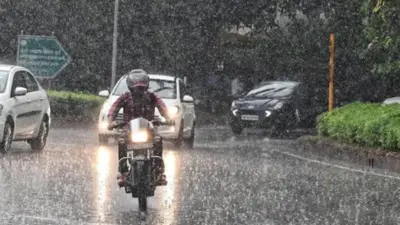
The India Meteorological Department has forecast heavy to very heavy rainfall, thunderstorms, lightning and strong winds across several states on September 28. Yellow alerts have been issued for Maharashtra, Andhra Pradesh, Karnataka, Tamil Nadu, Uttarakhand, Himachal Pradesh and Jammu and Kashmir. Delhi is expected to see rain over the next three days. Heavy rain in Uttarakhand could raise the risk of landslides and road blockages. Strong winds of 30-40 kmph with gusts up to 50 kmph are likely over coastal Andhra Pradesh and Yanam.
The IMD has forecast fairly widespread to widespread rain in parts of northwest India, while rainfall activity is expected to increase in the Northeast and southern peninsula. Isolated heavy to very heavy showers are forecast in parts of northwest India. Uttarakhand is likely to see fairly widespread to widespread rainfall accompanied by thunderstorms and lightning on September 28. Isolated very heavy rainfall is expected over west Uttar Pradesh, while east Uttar Pradesh and Himachal Pradesh may also receive isolated heavy rain. The Northeast is also expected to remain wet, with heavy rainfall likely over Assam, Meghalaya, Nagaland, Manipur, Mizoram and Tripura on September 29-30.
The southwest monsoon continues to withdraw from parts of northwest India. It has withdrawn from most parts of Punjab, Haryana, Rajasthan, the whole of Delhi, and some parts of Uttar Pradesh and Gujarat. Cumulative rainfall from June 1 to September 26 was 749.2 mm, 12% below the normal of 853.4 mm. The depression over the Chhattisgarh-Madhya Pradesh region has moved away from West Bengal, reducing rainfall activity in south Bengal.
Indian Opinion Analysis
Both Times of India and Livemint report the IMD's forecast neutrally, with no discernible slant. Times of India focuses on the immediate yellow alerts and localised impacts like landslides in Uttarakhand, while Livemint provides broader context by noting the monsoon withdrawal and cumulative rainfall deficit of 12%. The coverage is uniform straight reporting. The key figure to watch is whether the ongoing rainfall significantly narrows the seasonal deficit before the monsoon fully retreats.
Coverage: 2 sources, 2 neutral
Sources (2): timesofindia.indiatimes.com (neutral report), livemint.com (neutral report)
This brief was synthesised by AI from the 2 sources linked above, so one read covers every framing they carry.
Updated: this story now draws on 2 sources.