


















Now Reading: PPF lump sum vs monthly: which builds a bigger corpus?
-
01
PPF lump sum vs monthly: which builds a bigger corpus?


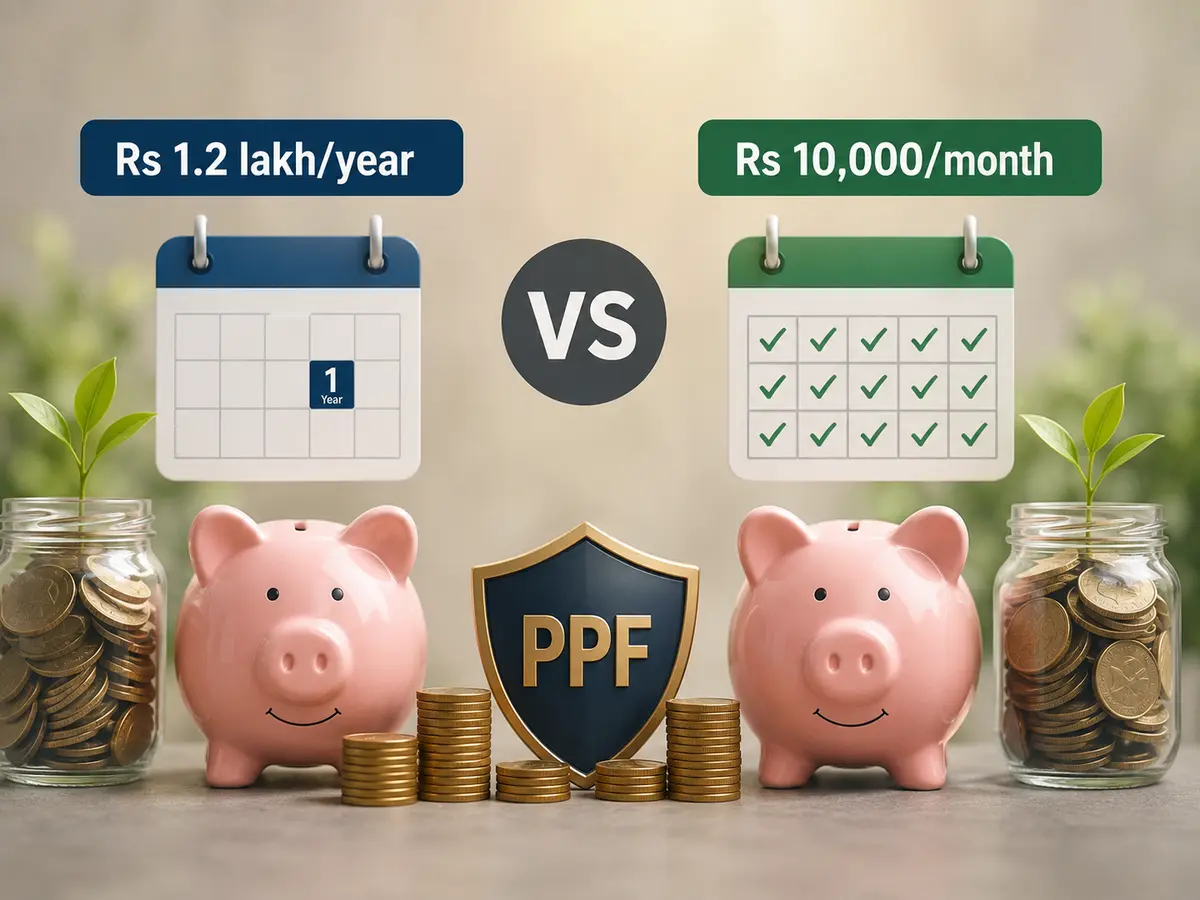
Investing Rs 1.2 lakh as a lump sum in the Public Provident Fund (PPF) before April 5 each year yields about Rs 99,000 more than investing Rs 10,000 per month over 15 years, assuming a constant 7.1% interest rate. The lump-sum approach generates a maturity amount of roughly Rs 32.55 lakh, compared to Rs 31.56 lakh for monthly investments. PPF interest is calculated on the lowest balance between the 5th and last day of each month, making the timing of the deposit critical.

Separately, an employee earning a basic salary of Rs 50,000 per month with 12% EPF contributions and 8.25% interest may build a Rs 2.23 crore corpus in 30 years, assuming 6% annual salary growth. Both projections assume rates remain unchanged for the full period, though the government reviews PPF rates quarterly and EPF rates annually. The next PPF rate announcement is expected for the October-December quarter.
Indian Opinion Analysis
The comparison between lump-sum and monthly PPF investment is a standard personal-finance calculation, not a policy story, so coverage is uniform and neutral. The calculation depends on the assumption that the lump sum is deposited before April 5 each year, a practical rule many investors may overlook. The EPF story, while also neutral, serves as a reminder that long-term salary growth and compounding, not just contribution frequency, drive retirement outcomes. A reader comparing the two schemes should note the PPF's 7.1% versus EPF's 8.25% rate and the 30-year horizon needed for the EPF goal. The next step is to check the government's next small-savings rate revision, due for the October-December quarter.
Coverage: 2 sources, 2 neutral
Sources (2): economictimes.indiatimes.com (neutral report), economictimes.indiatimes.com (2) (neutral report)
This brief was synthesised by AI from the 2 sources linked above, so one read covers every framing they carry. Methodology and corrections.
Updated: this story now draws on 2 sources.