















Now Reading: Smaller GCCs and chip startups reshape India’s engineering landscape
-
01
Smaller GCCs and chip startups reshape India’s engineering landscape



Over 420 global capability centres (GCCs) in India now have parent firms with revenues under $100 million, Nasscom data shows, signalling a shift toward leaner, engineering-led teams focused on AI and product…
The Story in Brief
Over 420 global capability centres (GCCs) in India now have parent firms with revenues under $100 million, Nasscom data shows, signalling a shift toward leaner, engineering-led teams focused on AI and product development rather than scale. Meanwhile, Indian semiconductor veterans from Intel, AMD and Texas Instruments are founding their own chip startups, with funding in the first half of 2026 already reaching $61.9 million, nearly 81% of the 2025 total.
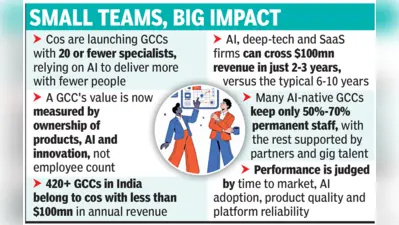
Industry experts say these trends reflect a democratisation of the GCC model and a new generation of investors backing locally owned intellectual property. Companies like Bose Professional are building specialised R&D centres in smaller cities, while startups such as Agrani and Turiyam AI have raised $7.1 million and $4 million respectively from venture capital firms.

The Indian Opinion
Both trends feed the narrative of India moving from a back office to an innovation hub. But the facts are more measured: most small GCCs still perform transactional work, and chip startups have raised only about $206 million since 2022, tiny compared to global peers. The real test is whether these ventures can convert talent and early funding into products that win customers globally, not just produce more press releases about India's potential. Can a $4 million seed company survive the capital-intensive semiconductor cycle? That number will settle the question.
Sources (2): timesofindia.indiatimes.com, timesofindia.indiatimes.com (2)
This story was synthesised by AI from the 2 sources linked above.
Updated: this story now draws on 2 sources.