















Now Reading: Corporate investment share of GDP declining since demonetisation
-
01
Corporate investment share of GDP declining since demonetisation

Corporate investment share of GDP declining since demonetisation

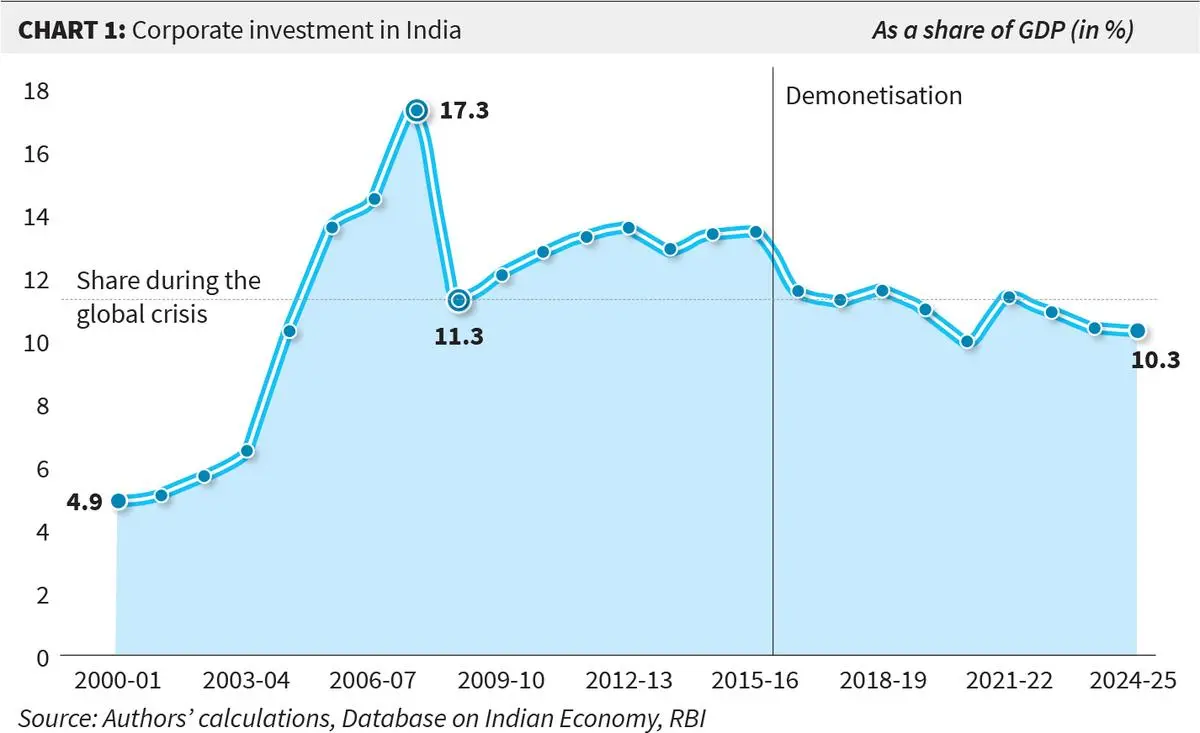
Corporate investment as a share of GDP in India has been on a prolonged decline since demonetisation in 2016, according to an analysis by The Hindu. The share fell from 10.3% in 2004 and has not recovered to even the low levels seen during the Global Financial Crisis. The article argues that demonetisation was a self-inflicted shock that pushed down profitability and confidence, particularly hitting small firms.

Separately, an Economic Advisory Council to the PM working paper, reported by Rediff, found that foreign-owned firms have reduced their investment intensity in India since FY20, while Indian business groups have increased theirs. The post-pandemic recovery is described as muted, driven by median firms rather than large 'superstar firms'. The paper also cites declining marginal profitability and rapid technological change in generative AI as reasons firms may be deferring investment.
Indian Opinion Analysis
The Hindu's analysis frames the investment decline as a self-inflicted wound from demonetisation, emphasising a 'damning' fall that external shocks like the GFC did not cause. The EAC-PM paper, as reported by Rediff, takes a more structural view: it points to global overcapacity, Chinese export subsidies, and generative AI uncertainty as reasons firms are holding back, and it notes that Indian business groups are actually investing more. The two are not in conflict, The Hindu diagnoses a lasting confidence shock from a single policy event, while the EAC-PM paper explains ongoing caution through global and technological headwinds. The measured takeaway is that both domestic policy credibility and external competitive pressures are suppressing investment. Watch for whether India's capital expenditure picks up after generative AI standards settle.
Coverage: 2 sources, 1 pro-government, 1 government-critical
Sources (2): thehindu.com (government critical), rediff.com (pro government)
This story was synthesised by AI from the 2 sources linked above. Methodology and corrections.
Updated: this story now draws on 2 sources.