












Now Reading: Gaganyaan module faces extreme heat, must survive re-entry
-
01
Gaganyaan module faces extreme heat, must survive re-entry


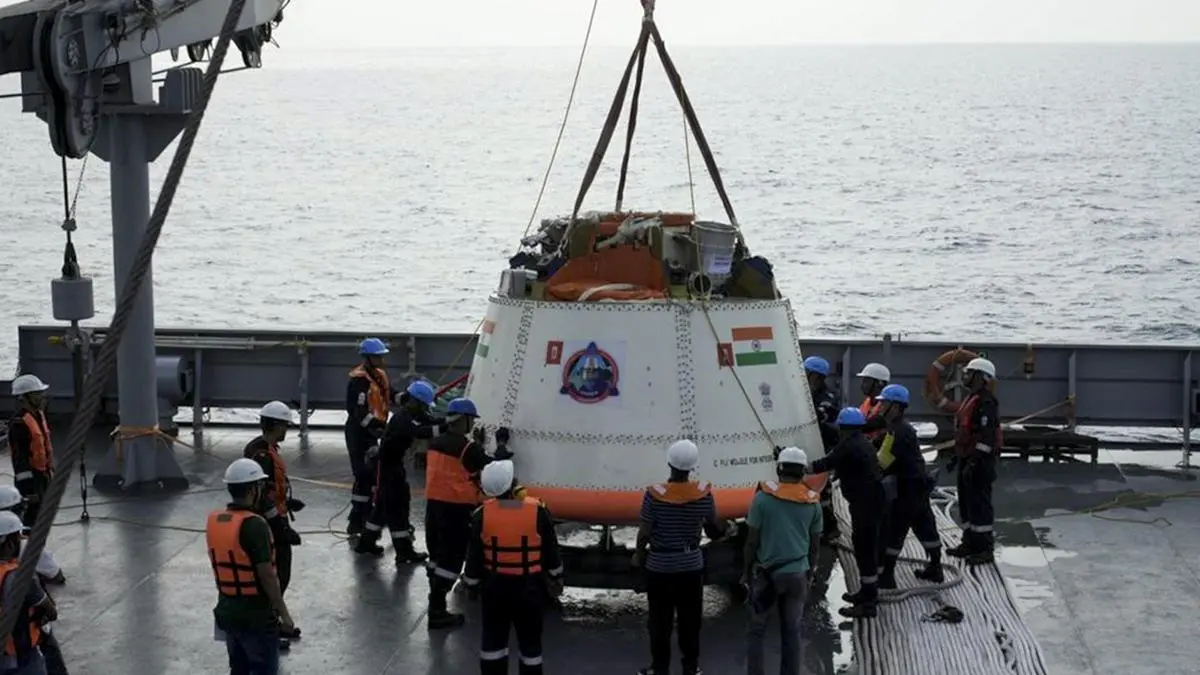
The Gaganyaan crew module will hit the Earth's atmosphere at a speed of 7,500 to 8,000 metres per second during re-entry. The Hindu reports that more than 99% of this kinetic energy is dissipated into the atmosphere as heat, but the small fraction directed back at the module is intense enough to melt it without a robust thermal protection system (TPS).

The TPS uses two methods: ablation, where material sacrificially chars and erodes to carry heat away, and thermal insulation, which uses low-conductivity materials to block heat from reaching the capsule's structure. The module must hit a precise re-entry corridor: too shallow and it bounces off the atmosphere, too steep and lethal deceleration and heat exceed survival limits. A communication blackout occurs when ionised plasma blocks radio signals, lasting until the capsule slows enough for the plasma to dissipate.
ISRO demonstrated re-entry capability with its 2007 Space Capsule Recovery Experiment. The Gaganyaan mission will use parachutes to slow the module from terminal velocity, still hundreds of kilometres per hour, to a soft landing in the sea. The precise launch date for the crewed mission is awaited.
Indian Opinion Analysis
The coverage is uniform straight reporting from The Hindu, with no discernible slant. Both articles focus on engineering challenges and solutions: blunt body theory, semi-ballistic steering, plasma blackout management, and parachute deployment. The middle ground is clear: re-entry is a well-understood but unforgiving physics problem, and ISRO's TPS design follows global precedents. What to watch: the next public milestone for Gaganyaan, likely an uncrewed test flight that will validate these systems in real conditions.
Coverage: 2 sources, 2 neutral
Sources (2): thehindu.com (neutral report), thehindu.com (2) (neutral report)
This story was synthesised by AI from the 2 sources linked above. Methodology and corrections.
Updated: this story now draws on 2 sources.