














Now Reading: D-Propulse demonstrates rotating detonation engine at DRDO facility
-
01
D-Propulse demonstrates rotating detonation engine at DRDO facility


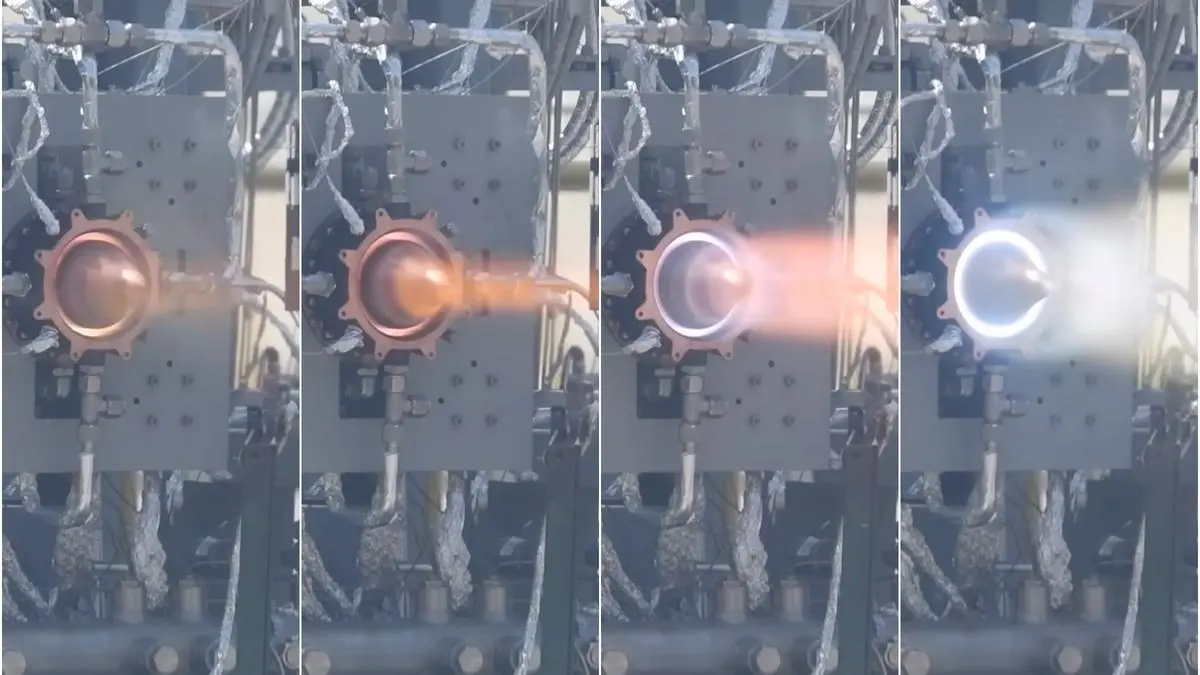
India-based defence start-up D-Propulse has successfully demonstrated a rotating detonation engine (RDE) at a Defence Research and Development Organisation facility in Hyderabad, according to reports by The Hindu and Sanskriti IAS. An RDE uses supersonic detonation waves that continuously rotate inside an annular combustion chamber, unlike conventional engines that rely on subsonic deflagration.

The technology promises 10% to 25% more thermodynamic efficiency than conventional combustors, which could reduce fuel requirements by roughly 17% for the same output. Several global firms including GE Aerospace, Lockheed Martin, SpaceWorks, Astrobotic, L3Harris, Stellar Alpina, Juno Propulsion and Venus Aerospace have also tested RDEs this year.
No RDE is yet ready for commercial or military use. The Hindu notes that building a working RDE requires precise control of fuel injection and internal pressure, materials that withstand over 2,000 degrees Celsius and 10-100 atmospheres, and advances in high-speed computing and diagnostics. Sanskriti IAS frames the breakthrough as strengthening India's indigenous capabilities in missiles, fighter aircraft, UAVs, space launch vehicles and high-speed weapons.
Indian Opinion Analysis
Both sources report the same technical facts neutrally, but their framing differs. The Hindu leads with global RDE developments and the science of detonation versus deflagration, emphasising that RDEs remain confined to R&D with no commercial models ready. Sanskriti IAS leads with the Indian breakthrough and concludes with its strategic importance for defence self-reliance and reduced foreign dependence. The Hindu is neutral-report: it includes no national pride framing. Sanskriti IAS is pro-government: it highlights the private sector's role alongside DRDO and the way forward for collaboration with IITs and universities. A careful reader should note that while India's test is significant, the technology is still experimental worldwide, and no timeline for deployment exists.
Coverage: 2 sources, 1 pro-government, 1 neutral
Sources (2): thehindu.com (neutral report), sanskritiias.com (pro government)
This story was synthesised by AI from the 2 sources linked above. Methodology and corrections.
Updated: this story now draws on 2 sources.