







Now Reading: India’s 10-coach hydrogen train, world’s most powerful, runs 6,000 km
-
01
India’s 10-coach hydrogen train, world’s most powerful, runs 6,000 km


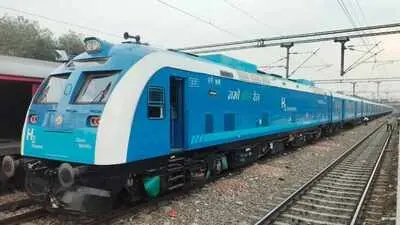
India's first hydrogen-powered train, flagged off last month by Prime Minister Narendra Modi, has covered 6,000 km on the Jind-Sonipat route in Haryana. The 10-coach, 3,200 HP trainset is the world's most powerful hydrogen train, running at up to 75 kmph and carrying 2,600 passengers.
The train emits only water vapour and has cut CO2 emissions by an estimated 36,444 kg, or nearly 36 tonnes, compared to a conventional DEMU. Its fuel cells generate electricity by combining hydrogen with oxygen, and the hydrogen storage and refuelling facility at Jind was developed indigenously by RDSO, ICF and Medha.
Indian Railways says tickets are priced at the same levels as ordinary DEMU services, Rs 10 to Rs 25. The train is seen as a green mobility option for stretches where electrification is difficult, such as the Kalka-Shimla heritage route. India aims to achieve net-zero emissions by 2030.
Indian Opinion Analysis
The 2,400-kW hydrogen train places India alongside Germany, China, France, Italy, and others in a small club testing hydrogen rail, but the scale of this 10-coach, 3,200-HP trainset is unmatched globally. Most hydrogen trains elsewhere run just two or three coaches. Indian Railways aims for net-zero emissions by 2030, but the current contribution of hydrogen trains will remain limited until a refuelling and production ecosystem is built. The Jind-Sonipat route, spanning roughly 80 km, is a low-risk test bed: flat, not heavily trafficked, and close to the Jind hydrogen facility. The real feasibility test will be on tougher terrain such as the Kalka-Shimla heritage line, where electrification is impractical and hydrogen might prove its value. The Railways will need to demonstrate that the per-kilometre cost, including green hydrogen production and storage, can compete with diesel on non-electrified routes before expanding beyond this single corridor.
Source: timesofindia.indiatimes.com
This brief was synthesised by AI from the source linked above. Methodology and corrections.