




















Now Reading: British Raj built 4,000-km thorn wall to tax salt
-
01
British Raj built 4,000-km thorn wall to tax salt


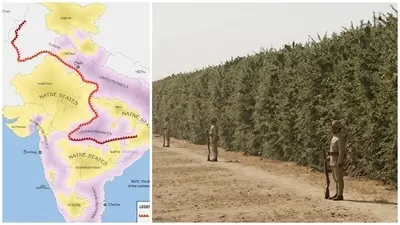
British colonial administrators built a 4,000-kilometre wall of thorny bushes across India in the 19th century to stop untaxed salt from entering areas where the British charged higher duties. Known as the…
British colonial administrators built a 4,000-kilometre wall of thorny bushes across India in the 19th century to stop untaxed salt from entering areas where the British charged higher duties. Known as the Great Hedge of India, the barrier stretched from Multan in present-day Pakistan to Odisha and reached 10, 12 feet in height.
The Inland Customs Line employed about 12,000 people in 1869, 70 and operated 1,727 customs posts. It collected approximately ₹1.25 crore in salt tax that year, while maintenance cost about ₹16.2 lakh. By 1877, salt tax across British India reached roughly £6.3 million.
The hedge was abandoned in 1879 after tax rates were made more uniform across India. Within decades, it almost vanished. The system was overseen by Allan Octavian Hume, who later co-founded the Indian National Congress.
Indian Opinion Analysis
Salt was taxed by Indian rulers long before the British, but the Raj turned it into a fiscal backbone by enforcing a uniform customs barrier across the subcontinent. The hedge was the physical expression of a policy that affected every household: salt was a necessity with no substitute, so demand was inelastic and revenue predictable. By 1879, when the line was abolished, the principle of a uniform salt tax had already been established, making a physical barrier obsolete. The shift from a 4,000-km hedge to a unified tax points to the deeper logic of colonial administration: control through standardisation rather than brute walls. What remains striking is the sheer scale of manpower, 12,000 employees, required to enforce a levy on a single ingredient.
Source: hindustantimes.com
This brief was synthesised by AI from the source linked above.