


















Now Reading: Gurugram floods expose gap in civil engineering education
-
01
Gurugram floods expose gap in civil engineering education


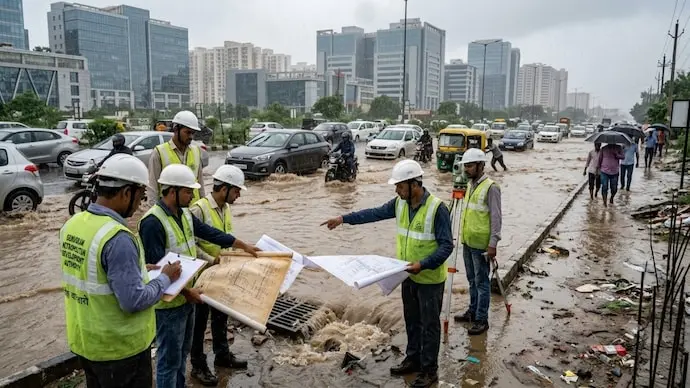
Gurugram's severe waterlogging after August 24 rains has become a test case for India's civil engineering education standards, with experts highlighting a persistent gap between classroom theory and field application. A section of road near IFFCO Chowk caved in on August 26 after water washed away soil underneath, while the district administration had already advised work-from-home and online schooling for the following day.
AICTE data shows 1,72,936 students enrolled in civil engineering B.Tech programmes in 2024-25, making it India's third-largest engineering discipline. Yet the Knight Frank-RICS assessment projects only about 1.8 lakh civil engineers entering the construction sector annually over the coming years, with Reuters reporting that roughly half of those graduating do not stay in the field due to skill mismatches.
Industry professionals and academics argue that many graduates know theory but cannot diagnose real-world problems, read a construction site, or coordinate with contractors. Professor Ashwin Majumdar of ITS Engineering College proposed sending final-year students to analyse actual flooding scenarios in Gurugram to test hydrology, surveying, drainage and project management skills.
Indian Opinion Analysis
The disconnect between engineering education and on-site readiness is a longstanding structural problem. The AICTE regulates curriculum breadth but not practical competency, the Construction Industry Development Council has repeatedly flagged that graduates lack exposure to real-world project management and site execution. India's construction sector, which contributes about 9% to GDP and employs over 5 crore people directly and indirectly, cannot absorb engineers who cannot read a site. The immediate signal to watch is whether the Ministry of Education's National Credit Framework, currently under pilot, will mandate industry internships for civil engineering degrees, and whether state public works departments start issuing skill-testing entry exams modelled on the Gurugram flooding scenario.
Source: indiatoday.in
This brief was synthesised by AI from the source linked above. Methodology and corrections.