












Now Reading: Maharashtra tightens rules for birth, death record corrections
-
01
Maharashtra tightens rules for birth, death record corrections


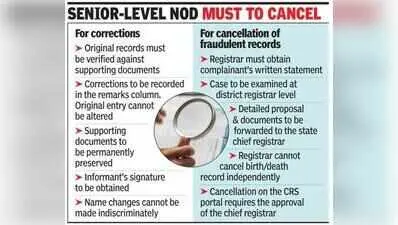
Maharashtra has tightened the procedure for correcting or cancelling birth and death records, making documentary verification mandatory and requiring higher-level approval for fraudulent entries. The guidelines, issued on September 4 by the…
Maharashtra has tightened the procedure for correcting or cancelling birth and death records, making documentary verification mandatory and requiring higher-level approval for fraudulent entries. The guidelines, issued on September 4 by the state's Directorate of Health Services and Chief Registrar of Births and Deaths, specify that no registrar can cancel a record alone. Any suspected fraudulent entry must be examined at the district level and forwarded to the state Chief Registrar and Director of Health Services for approval.
The move follows complaints by former BJP MP Kirit Somaiya about alleged irregularities in delayed birth registrations at the Brihanmumbai Municipal Corporation. The guidelines also bar altering original birth records for name changes, parental divorce, or address changes after registration. For corrections, the original entry remains unchanged, with amendments noted in the remarks column. All supporting documents must be attached to the register permanently.
Indian Opinion Analysis
The new rules close a loophole that had made birth and death records vulnerable to manipulation, especially for immigration, identity fraud, or property claims. Under the Registration of Births and Deaths Act, 1969, state governments are empowered to prescribe procedures for corrections. Maharashtra's directive specifically targets fraudulent cancellations, which could have been used to create fake identities or erase records for monetary gain. The requirement for district-level scrutiny and state-level approval for cancellation adds a layer that did not exist uniformly before. The Brihanmumbai Municipal Corporation's alleged irregularities in delayed registrations, flagged by former BJP MP Kirit Somaiya, appear to have accelerated this reform. The test will be in enforcement: registrars now have clear paperwork rules, but compliance across 36 districts will determine if malpractice actually drops.
Source: timesofindia.indiatimes.com
This brief was synthesised by AI from the source linked above.