













Now Reading: How India’s Pralay missile stands out among short-range ballistic missiles
-
01
How India’s Pralay missile stands out among short-range ballistic missiles

How India’s Pralay missile stands out among short-range ballistic missiles

Short-range ballistic missiles have become a defining weapon in modern conflict, as seen in the wars in Europe and West Asia. Russia's Iskander-M missiles have been used extensively against Ukraine, while Iran has fired waves of short- and medium-range ballistic missiles at Israel, testing even the Iron Dome and Arrow interceptors. Intercepting these missiles remains extremely challenging because they spend little time in the exo-atmospheric phase, giving defenders a very short window to detect and engage them. When the missiles can manoeuvre during their terminal approach, as quasi-ballistic designs do, the difficulty compounds further.
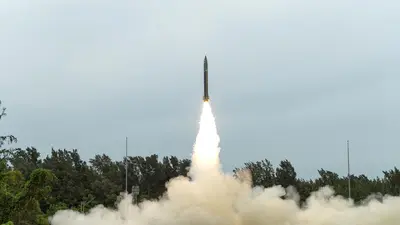
India's Pralay missile, developed by the Defence Research and Development Organisation, is designed to fill a specific gap: a conventionally armed strike option that operates outside India's nuclear No First Use doctrine. It is a canisterised, road-mobile tactical ballistic missile that can be stored and fired at short notice. With a range of 150 to 500 kilometres and a payload capacity of 350 to 1,000 kilograms, Pralay can be fitted with high-explosive fragmentation, penetration-cum-blast or runway-denial submunitions. Its solid-fuel propulsion and terminal-phase manoeuvrability place it in the quasi-ballistic category alongside China's Dongfeng-12 and Russia's Iskander.
Pralay is slated to join India's Integrated Rocket Force alongside BrahMos, Nirbhay and Pinaka. Its combination of speed, trajectory unpredictability and warhead flexibility makes it one of the most capable short-range ballistic missiles in its class.
Indian Opinion Analysis
India's conventional missile triad has long had a gap between the 290-km Prahaar and the nuclear-capable Agni series. Pralay fills that gap, giving the military a quick-reaction option to strike hardened targets deep inside enemy territory without crossing the nuclear threshold. The missile's road-mobility and canisterised launch make it hard to target preemptively. Watch for the first induction batch to be assigned to the newly raised Integrated Rocket Force, and for subsequent tests to validate the terminal-phase manoeuvres against simulated air-defence radars.
Source: timesofindia.indiatimes.com
This story was synthesised by AI from the source linked above. Methodology and corrections.