













Now Reading: India delivers key beam catcher to mega science project FAIR in Germany
-
01
India delivers key beam catcher to mega science project FAIR in Germany

India delivers key beam catcher to mega science project FAIR in Germany

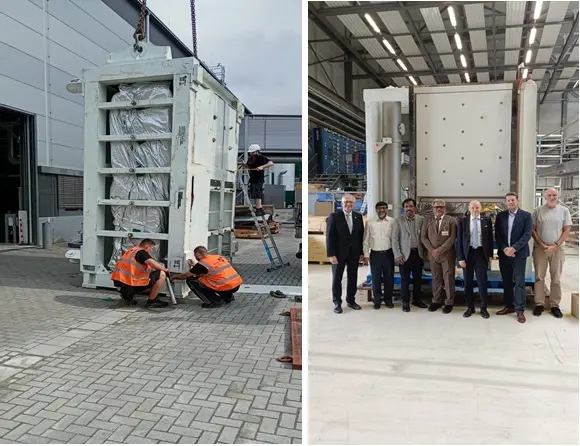
The first of three beam catcher units, critical equipment for the Facility for Antiproton and Ion Research (FAIR) in Darmstadt, Germany, has reached the site and awaits installation. Designed by CSIR-CMERI in…
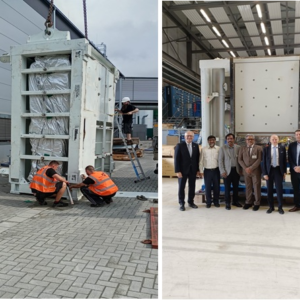
The first of three beam catcher units, critical equipment for the Facility for Antiproton and Ion Research (FAIR) in Darmstadt, Germany, has reached the site and awaits installation. Designed by CSIR-CMERI in Durgapur under the supervision of Bose Institute, the beam catcher absorbs remnants from high-energy heavy-ion beams and is among India's key in-kind contributions to the international mega science project.
The beam catcher's absorber, made of fine-grained graphite and hyper pure copper, must withstand extreme energy densities up to 300 J/g per pulse, generating thermal shock waves. The unit weighs about 40 tonnes and is housed in a vacuum chamber. India became a founding member of FAIR in 2010, with its contributions funded jointly by the Department of Science and Technology and the Department of Atomic Energy. Indian industries are also supplying ultra-high vacuum chambers, power converters, and cables for the accelerator.
Indian Opinion Analysis
India's in-kind contribution to FAIR is a rare example of domestic engineering firms supplying critical components for a frontier physics facility abroad. The beam catcher is one of only three units globally, highlighting India's niche capability in heavy engineering under ultra-high vacuum. Beyond hardware, Indian scientists are developing advanced detectors for the NuSTAR and CBM experiments at FAIR. The project is a test of India's ability to deliver complex scientific infrastructure to international standards, with further in-kind deliveries expected as FAIR's beam commissioning approaches.
Source: dst.gov.in
This brief was synthesised by AI from the source linked above.